

Designing beyond the org chart
What happens when an organization is designed around accountability— not just employees?
I explored an organizational model that connects internal employees, external expertise, intelligent agents, and the work they collectively perform—while keeping human responsibility visible throughout the system.
AI and external expertise can perform work. Accountability remains human.
The organization is more than an org chart.
Traditional organizational models are good at showing where people sit. They are much less effective at showing how responsibility, external expertise, intelligent systems, work, and resources actually move through the organization.
This structure tells us who reports to whom.
The question changes from “Where does this person sit?” to “How does this organization operate?”
Organizational structure still matters. But structure alone cannot explain work.
Start with the human organization.
Before adding contractors, intelligent agents, or project economics, the system needs a stable foundation: the people who hold organizational responsibility.
Employees form the permanent internal hierarchy.
 EMP-01
Director of Engineering
Organizational authority
 EMP-02
Engineering Manager
Technical leadership
 EMP-05
Project Manager
Project accountability
 EMP-07
Resource Manager
Capacity + allocation
 EMP-03
Senior Project Engineer
 EMP-04
Civil Engineer
 EMP-06
CAD / Design Specialist
 EMP-08
Field / Survey Engineer
Expertise can enter without entering the hierarchy.
Organizations often need specialized expertise or additional capacity without creating a permanent internal role. Contractors extend the workforce through the work itself.
Contractors connect to projects and work while an internal employee retains organizational accountability.
EMP-05
Project Manager
Holds internal accountability for the contracted work relationship.
Drainage Improvement
 CON-01
Hydraulic Engineer
Hydraulic analysis
 CON-02
CAD Specialist
Drawing production
 CON-03
Survey Specialist
Field survey support
 CON-04
Environmental Engineer
Environmental review
AI belongs to a person—not the hierarchy.
Intelligent agents can expand operational capacity, but they need a clear place in the organization. I treated each agent as an extension of a specific employee rather than as an independent organizational actor.
Every active AI agent remains directly connected to one accountable human employee.
Engineering Manager
Owns technical responsibility and reviews agent-assisted engineering work.
Checks drawing packages against defined criteria.
Supports technical research and specification lookup.
Flags inconsistencies for human review.
Project Manager
Owns project coordination and approves agent-supported planning outputs.
Supports sequencing, milestones, and schedule checks.
Synthesizes project activity into structured summaries.
Surfaces potential project issues for evaluation.
Human ownership remains explicit.
Accountability cannot terminate in another agent.
Structure becomes useful when it connects to work.
The organizational hierarchy and the work structure are different systems. The model becomes operational when the people accountable for the organization connect to the projects, deliverables, and tasks being executed.
Employees bridge organizational responsibility and project execution.
Where responsibility lives.
Project Manager
Holds organizational and project responsibility.
The employee remains inside the permanent organizational hierarchy. The agent does not.
Where execution happens.
Update drainage plan
A task can connect internal employees, external expertise, and employee-owned agents without treating them as the same kind of organizational actor.
Senior Project Engineer
Assigned to project work through the internal organization.
Contract Hydraulic Engineer
Connected through project work rather than the employee hierarchy.
Design Review Agent
Assists work under direct ownership of a human employee.
The organization exists to deliver something real.
Organizational structure becomes meaningful when it is connected to an outcome. To test the model, I placed it inside a civil engineering project where internal teams, external specialists, and intelligent agents contribute to the same body of work.
The project gives organizational relationships a shared operational context.

A real project requires more than organizational structure. It requires coordinated expertise, decisions, work, review, and delivery.
The same project can be viewed through three different layers. Each answers a different operational question.
Who is responsible?
Internal roles establish authority, ownership, and accountability for delivery.
Who or what can contribute?
Employees, contractors, and employee-owned agents provide different forms of project capacity.
What must be delivered?
Projects become deliverables, work packages, and tasks that can be assigned and evaluated.
Organizational capacity becomes engineered work.
Inside the project, abstract relationships become specific assignments: analyze conditions, develop drawings, coordinate technical decisions, update plans, and prepare work for review.
Completed work still needs a decision.
A task can be executed by an employee, contractor, or intelligent agent without automatically becoming accepted project work. Execution records what was produced. Acceptance records a human decision about whether that work is ready to move forward.
Execution can be distributed. Acceptance remains an explicit point of accountability.
The work was performed.
An assigned actor produced the requested output. The system can record who or what contributed, when it occurred, and what was produced.
The work can move forward.
An accountable human reviewed the output and made a decision: accept it, return it for revision, or prevent it from progressing.
The first output does not have to be the final output.
Technical work often moves through review and revision before it becomes accepted project work. Instead of treating this as failure, the system preserves the review cycle as part of the work history.
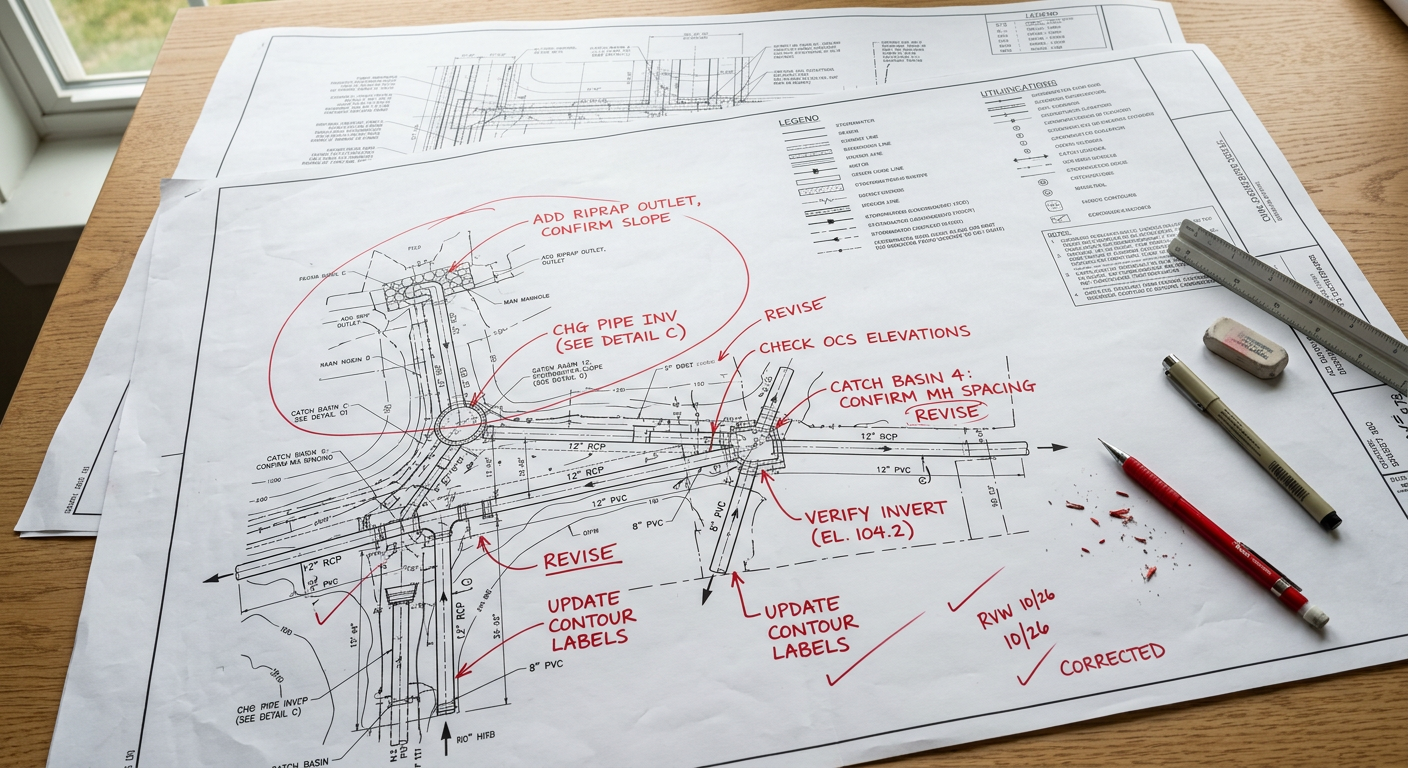
The system makes the review cycle visible instead of collapsing production and approval into a single “complete” state.
Output produced.
Output evaluated.
Return to active work.
Count toward accepted work.
The system records the decision. It does not make accountability disappear.
Acceptance does not claim that work is objectively perfect. It records that an authorized human reviewed the available output and made the decision to move it forward.