

Bridging the Discovery Gap in Youth Recreation
Re-architecting fragmented local information channels to halt the systemic youth athletic drop-out rate.

Executive Summary
By age 13, 70% of children in the U.S. abandon organized sports. While traditional frameworks point to burnout or cost, our system analysis identifies an earlier friction: severe program misallocation caused by fragmented discovery channels.
Parents currently navigate siloed municipal portals, static PDFs, and word-of-mouth networks. This opacity creates placement mismatches in skill expectations and scheduling logjams.
This study outlines a Retention-First Framework, replacing opaque listings with structured intensity tags, multi-child calendar synchronization, and transparent program cultures to keep kids engaged long-term.
From Foundational Research to an Independent Product System
The Recreation System evolved through two distinct phases: an initial research investigation into family recreation access and an independent product-design effort that translated those findings into a connected mobile experience.
Foundational Research
The project began in 2021 as a nine-month research initiative completed during a Research Boot Camp. The assignment focused on understanding how parents discover, evaluate, and access local recreation opportunities. Producing a finished digital product was not a program requirement.
Independent Product Development
After completing the research, I independently extended the findings into a product strategy and mobile system. I later revisited the work to strengthen its architecture and build a complete experience spanning program discovery, household coordination, and enrollment.
I led the research synthesis, product strategy, system architecture, interaction design, and high-fidelity redesign. The foundational research originated during the Boot Camp, while the product concept and interface were developed independently.
Problem Narrative: The Anatomy of Attrition
Informational Gap

Outdated listings, scattered municipal portals, and opaque program culture.
Mismatched Placement

Incorrect skill intensity alignment, scheduling friction, and operational burnout.
Early Dropout (70%)

Frustration and abandoned participation by age 13 due to system friction.
1. The High Cost of Opaque Discovery
When a parent seeks a recreation program, they aren't just buying a service; they are committing family time, financial resources, and their child’s developmental baseline. Today’s landscape forces parents to navigate a fractured ecosystem:
- Information Fragmentation: Municipal park sites, private clubs, and local leagues operate in silos, requiring parents to manage dozens of accounts, spreadsheets, and calendar apps.
- Culture & Intensity Blindness: Standard directory listings state where and when, but omit how. Parents cannot gauge whether a league is focused on low-stakes skill development or hyper-competitive play, leading to placement mismatches.
- Operational Exhaustion: Multi-child households face compounding logistics. A single scheduling overlap or hidden uniform fee can result in a child being pulled from a program entirely.
2. From Search Friction to Childhood Attrition
The 70% drop-out rate at age 13 is the symptom; mismatched onboarding is a primary cause. When a beginner child is inadvertently placed in an over-competitive environment due to vague program descriptions, anxiety replaces fun. Conversely, when an athletic child lacks structured progression, boredom sets in.
Because current tools offer zero visibility into program culture, skill expectations, or long-term growth pathways, parents default to trial-and-error enrollment—a strategy that exhausts family bandwidth and ultimately pushes children out of sports altogether.
3. The Product Opportunity
To reverse the drop-out trend, we must solve the discovery problem at the systemic level. Re-imagining the recreation channel requires moving beyond a simple "search directory" to a matching and retention engine:
Understanding Where Recreation Access Breaks Down
The research examined how parents found local activities, what information influenced their decisions, and where existing municipal discovery and registration experiences created unnecessary friction.
Moderated Usability Testing
Four parents attempted to find, evaluate, and register for an activity using an existing municipal recreation website.
Semi-Structured Interviews
Three interviews explored search behavior, program-selection priorities, family constraints, and previous recreation experiences.
Qualitative Synthesis
Questionnaires, comparative analysis, affinity mapping, and thematic categorization connected observed behavior with recurring needs.
One participant was both a parent and recreation stakeholder. Several participants contributed to more than one research activity.
“Duration, location, cost, and organizational structure are my key concerns before I begin my search.”
“Having a variety of levels helps me understand whether a program is right for my child.”
“Typically, the competition level correlates with the time commitment.”
These findings reflect a small formative sample and were used to identify design opportunities rather than make population-level claims. A System Usability Scale questionnaire was administered, but one automatically calculated response produced a questionable outlier; SUS results were excluded in favor of observed task completion and interview evidence.
Broader participation context: American Academy of Pediatrics, “Overuse Injuries, Overtraining, and Burnout in Young Athletes,” 2024 . The AAP reports that approximately 70% of youth athletes discontinue organized sports by age 13. Attrition is multifactorial; this case study focuses on discovery and household friction as one addressable barrier.
Translating Evidence Into System Requirements
The redesign did not begin with a predefined feature list. Observed usability breakdowns and parent decision criteria were translated into specific product requirements.
Participants did not discover or use the existing search filter.
Prominent, readable filters organized around age, intensity, and household compatibility.
Parents prioritized duration, location, cost, program level, and organizational structure.
Standardized program cards with intensity, time, travel, coaching, culture, and transparent fee information.
Only one of four participants completed the existing journey from discovery through registration.
One connected mobile flow from program comparison through waiver authorization, payment, and confirmation.
Parents evaluated activities within the constraints of the entire household—not as isolated enrollments.
Multi-child conflict detection, guardian coordination, shared calendars, and real-time schedule alerts before payment.
Program-Fit Transparency
Help families assess culture, commitment, travel, and cost before enrolling.
Household Compatibility
Identify multi-child schedule and transportation conflicts before they become enrollment problems.
Reusable Enrollment
Reduce repeated paperwork through saved family information, digital waivers, and connected payment.
Ecosystem Stakeholders & User Archetypes
Resolving attrition requires addressing the dual-sided friction between demand-side family logistics and supply-side operational constraints.

The Overwhelmed Logistician
- Transparent Culture & Skill Tags: Clear indicators of program intensity before enrolling.
- Multi-Child Calendar Sync: Centralized schedule visibility across multiple leagues and age groups.
- Frictionless Paperwork: Single-pass digital waivers and automated recurring commitments.

The Resource-Constrained Operator
- Automated Roster Retention: Tools to reduce mid-season churn and maintain stable league income.
- Standardized Listing Metadata: Simple frameworks to convey skill expectations accurately.
- Unified Parent Channels: Direct broadcast capabilities for weather updates and calendar shifts.
System Architecture: Retention-First Framework
To bridge the discovery gap, the system re-architects how program metadata is structured, transforming static listings into transparent, intent-based matching engines.
1. Culture & Intensity Tagging
Replaces vague "Under-12" categories with clear indicators (Recreational, Developmental, Competitive) so families align expectations before registering.
2. Unified Household Calendar
Consolidates multi-child schedules, practices, and locations into a single feed with real-time updates and direct calendar synchronization.
3. Single-Pass Administrative Flow
Digitizes waivers, medical clearances, and recurring payments across municipal and private providers into a single unified profile.
RSA: Retention-First System Architecture
Tagging Engine
Distance Filter
High-Fidelity Solution Mechanics
Translating family and provider friction into connected digital interactions that improve program fit, surface household conflicts before payment, and streamline enrollment across community recreation providers.
Evaluate Program Fit Before Commitment
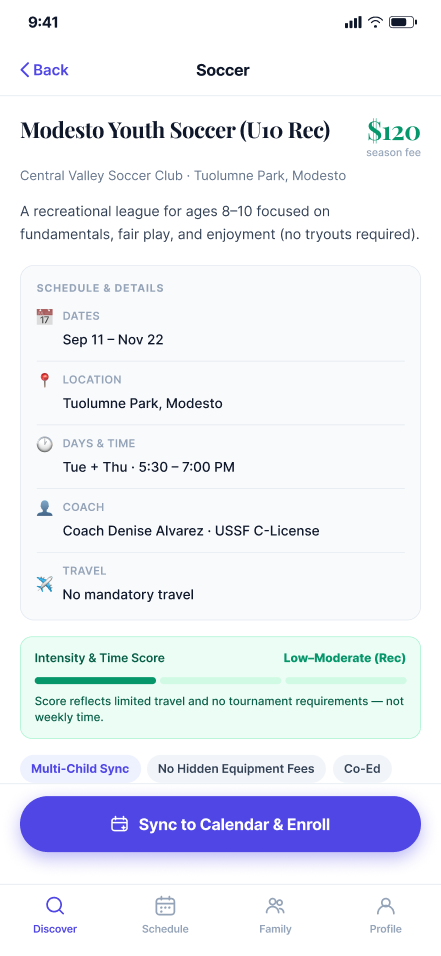
Instead of sending parents across disconnected municipal portals, static PDFs, and word-of-mouth channels, the system presents programs through consistent information about culture, intensity, schedule, travel, coaching, and total cost.
- Verified developmental-focus and recreational-intensity indicators
- Clear weekly schedules, travel expectations, and coach qualifications
- Transparent season pricing with no hidden equipment or travel fees

Detect Household Impact Before Enrollment
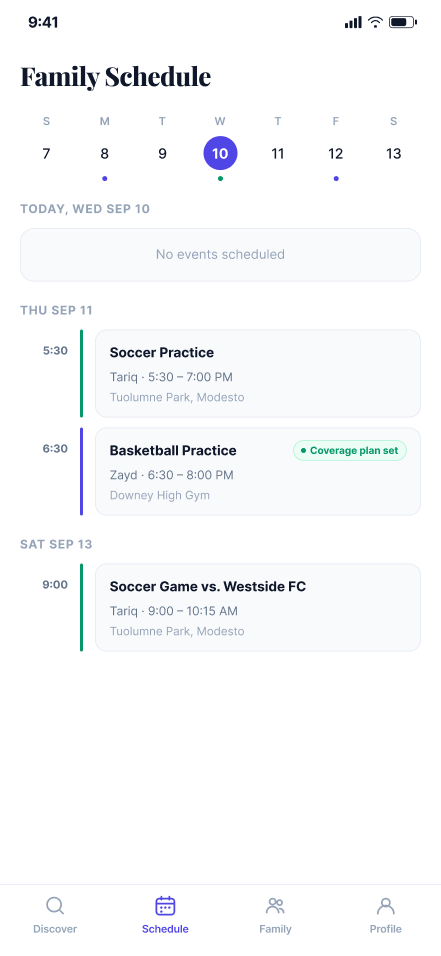
Before registration, the system compares a proposed program against every child’s activities, identifies scheduling and location conflicts, and recommends a coordinated household plan.
- Multi-child schedule and location conflict detection before payment
- Guardian coverage recommendations using time and proximity data
- Shared calendar synchronization with real-time practice and location alerts

Complete Enrollment in One Continuous Flow
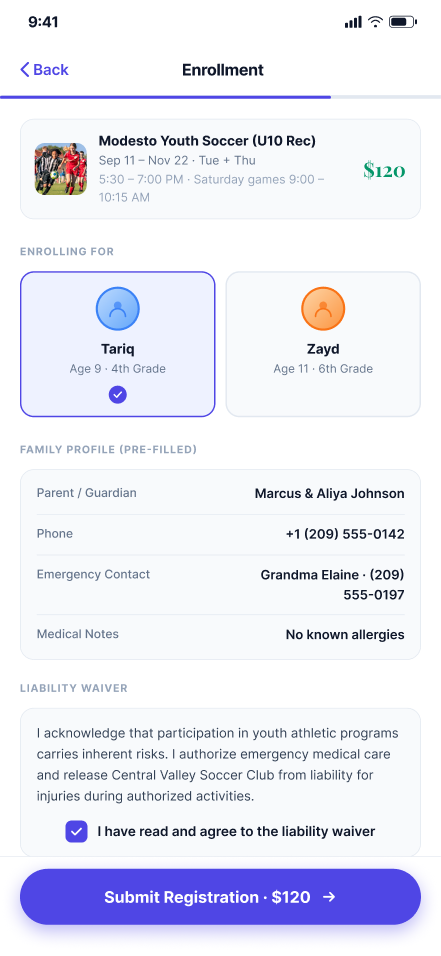
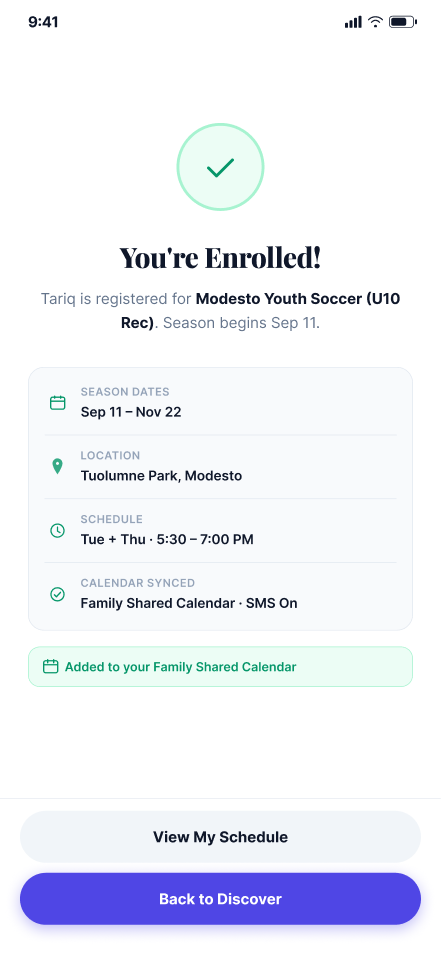
Reusable household information eliminates repeated paperwork while digital waivers, transparent payment, and calendar synchronization complete registration without sending parents to another system.
- Pre-filled guardian, emergency-contact, and medical information
- Digital liability authorization and transparent $120 payment
- Immediate confirmation and automatic addition to the shared family calendar
Validation Plan & Proposed Success Measures
The high-fidelity system represents an independently developed concept, not a launched municipal product. The next phase would test whether the redesigned experience improves informed decision-making and reduces preventable household friction.
Proposed Usability Study
Parents would complete the primary Recreation System journey while researchers evaluate comprehension, trust, task completion, and decision confidence.
- Find an age-appropriate recreational program
- Evaluate its intensity, schedule, travel expectations, and total cost
- Identify a conflict involving another child
- Review and confirm a household coordination plan
- Complete enrollment using saved family information
- Verify that the program appears on the shared calendar
Proposed Pilot Measures
These measures are intended for future validation and should not be interpreted as measured project outcomes.
Key Takeaways & Next Steps
- Systemic Retention Over Fast Acquisition: Fixing youth sports dropout isn't just a marketing problem—it's an operational data problem solved through better expectation setting.
- Pilot Testing Expansion: Validating multi-child calendar synchronization with regional park districts and independent sports clubs.
- Director Dashboard Suite: Expanding supply-side operational features for attendance tracking, roster management, and automated weather broadcasts.